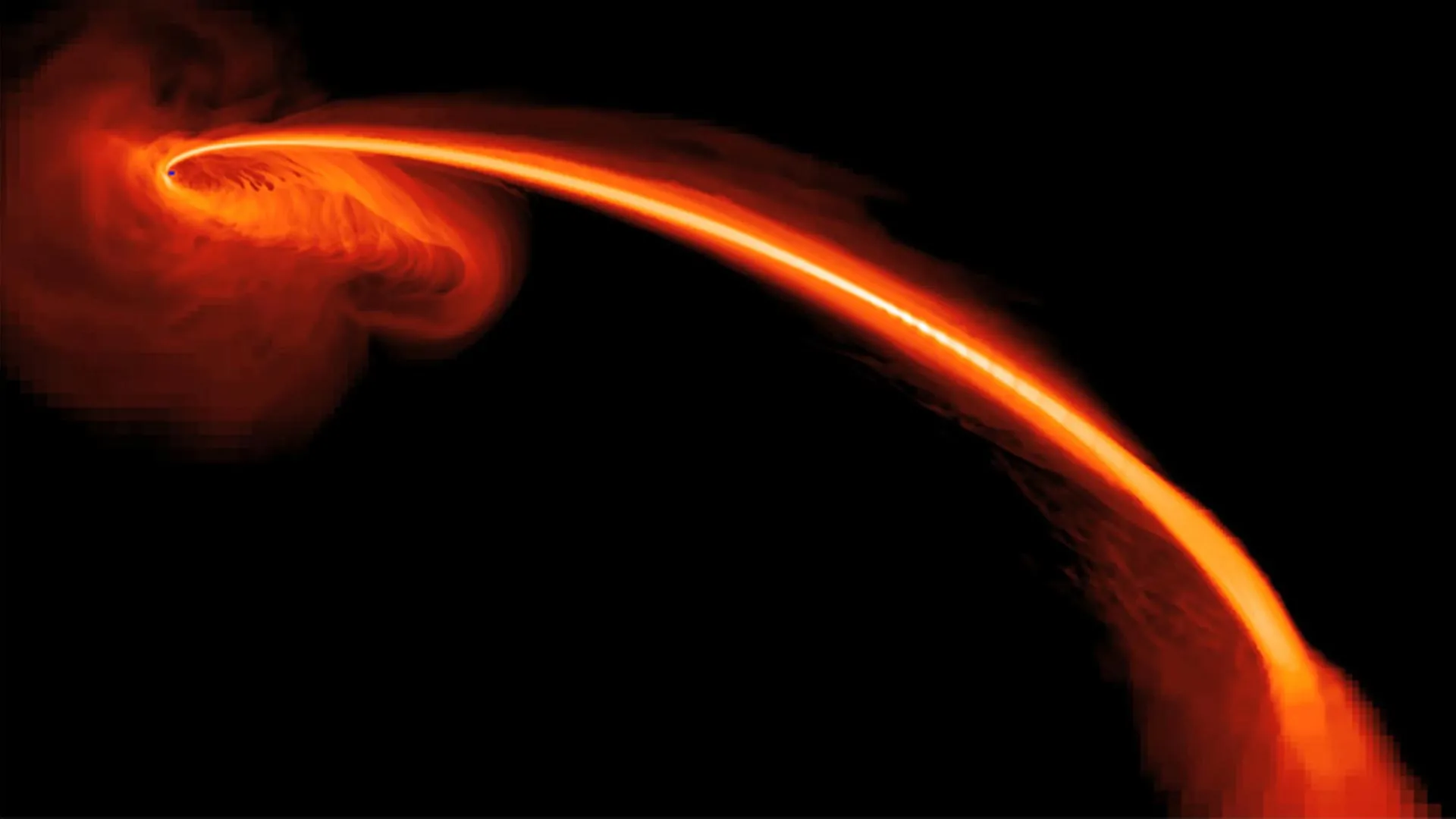
Astronomers have discovered stars that repeatedly pass close to supermassive black holes and survive, emitting bursts of light. Researchers are investigating why the flares from these encounters sometimes diminish with each orbit, and believe the stars’ initial rapid spin may be the key.
Astronomers have found stars that repeatedly skim past supermassive black holes, surviving each encounter while producing a new burst of light. These systems are puzzling scientists, as the flares sometimes mysteriously fade with each return pass. The research details how stars can withstand the immense gravitational forces and continue to orbit.
Researchers now think the key may be stars that were already spinning extremely fast before being captured. According to the source, that rapid rotation could explain both the fading flares and how the stars ended up in such extraordinarily tight black hole orbits. The initial speed appears to be a crucial factor in their survival and orbital behavior.
The study focuses on understanding the dynamics of these extreme environments and the unusual characteristics of the stars involved. While the exact mechanisms are still under investigation, the rapid rotation is a leading hypothesis to explain the observed phenomena. The findings contribute to a better understanding of how stars interact with supermassive black holes and the conditions that allow them to survive these encounters.
Leer la cobertura original
💬 Comentarios
📜 Política de comentarios