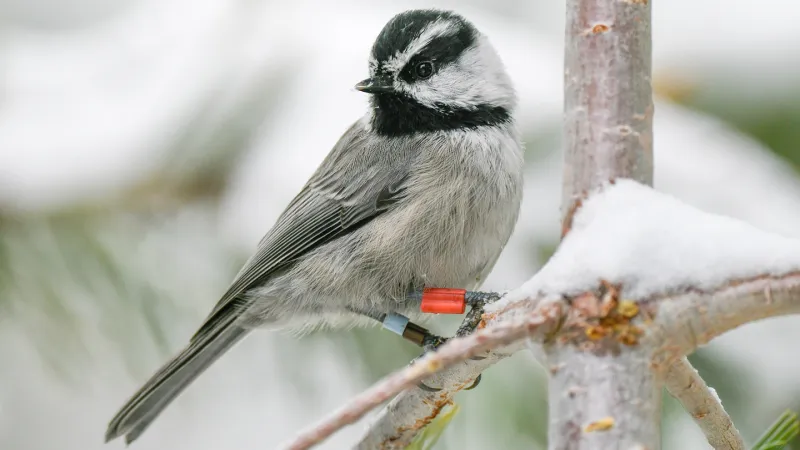
A long-term study in the Sierra Nevada mountains reveals a strong link between a mountain chickadee’s spatial memory and its ability to survive harsh winters and reproduce. Researchers at the University of Nevada, Reno (UNR) have been studying the birds for decades, utilizing automated technology to test the memory of up to 250 individuals annually.
Behavioral ecologist Ai Ana Richmond notes that mountain chickadees, weighing about as much as a pencil, must quickly locate hundreds of thousands of stashed pine nuts during the winter to avoid succumbing to the cold. The research, conducted at the Sagehen Creek Field Station near Truckee, California, demonstrates that approximately two-thirds of chickadees do not survive their first winter, but those that do can live for a decade or more – with the smartest birds living the longest, as reported in *Science* in 2024.
Vladimir Pravosudov, a behavioral ecologist at UNR, initiated the study in 1999, building on his earlier work with tits in Russia. He wanted to understand why animals need good memories in a realistic setting. The team developed specialized feeders in 2013 that use technology similar to hotel key cards, opening only for specific, banded birds identified by microchips on their legs. This allows researchers to test the birds’ spatial memory in the wild.
According to behavioral ecologist Katherine Johnson, understanding the importance of memory for chickadees allows researchers to explore what factors influence these abilities and how they impact reproductive success. The birds, known as a’ni ki in the Shoshone Indigenous Goshiute dialect, store single-seed stashes in tree crevices “in brutal conditions,” often with over four meters of snow on the ground.
Leer la cobertura original
💬 Comentarios
📜 Política de comentarios