U.S. Bases Face Mounting Iranian Attacks, Leading to Bomber Relocation
AI-synthesized · Bias removed · Facts only
2 sources: 1 left · 0 center · 1 right
Facts are sacred. Opinion is labelled.
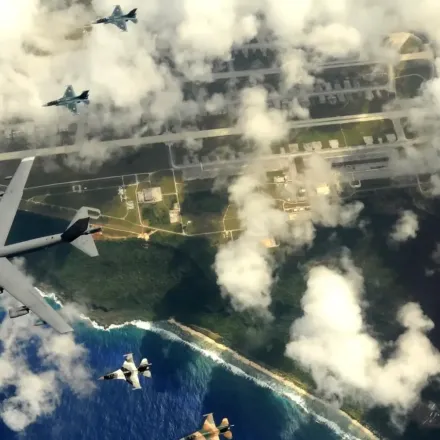
Image: The Intercept
The U.S. military has relocated B-1 bombers stationed in the United Kingdom following a perceived threat of attack by Iran, as a series of strikes targeting American bases across the Middle East escalate. A “sophisticated plot” to attack Royal Air Force Fairford with drones prompted the Pentagon to move the 12 bombers, with officials suggesting Iran’s Islamic Revolutionary Guard Corps may have recruited U.K. nationals. These attacks, which have killed 19 U.S. troops and wounded nearly 900 since July, are occurring despite claims by President Trump and Pete Hegseth that Iran’s military capabilities have been decimated. The strikes have damaged or disrupted operations at multiple bases, including facilities in Bahrain, Qatar, Kuwait, the UAE, Saudi Arabia, Cyprus, and Diego Garcia. One Navy official stated that Iranian attacks “blew the hell out of Bahrain,” impacting the USS Abraham Lincoln’s supply chain. While President Trump has attempted to pressure Iran through a naval blockade and restrictions in the Strait of Hormuz, the conflict has exposed vulnerabilities in U.S. base security, with some bases sustaining damage that may be irreparable. Iran is reportedly pursuing a “go for broke” strategy, attempting to withstand economic pressure longer than the U.S. can sustain the war and naval operations, coupled with the impact of high fuel prices. The official U.S. casualty toll is believed to be obscured, with one defense official citing a “cover-up.”
Where they differ
- The Intercept emphasizes the scale of casualties and the alleged cover-up of the true toll, while the New York Post focuses on the strategic deficiencies exposed by the attacks.
- The Intercept frames the conflict as a “festering wound” for the U.S. military, while the New York Post highlights the need for innovation to address the threat to bases.
- The New York Post draws a historical parallel to Winston Churchill’s views on evacuations, framing the bomber relocation as potentially embarrassing, a point not made by The Intercept.
What is not yet known
- The full extent of the alleged cover-up regarding U.S. casualties remains unclear.
- Whether the U.S. will implement a broad pullback of its presence in the region is still undecided.
Background
- The U.S. military maintains bases in several Middle Eastern countries including Bahrain, Qatar, Kuwait, the UAE, Saudi Arabia, Cyprus, and Diego Garcia [background knowledge].
- Iran’s Islamic Revolutionary Guard Corps (IRGC) is a branch of the Iranian Armed Forces responsible for protecting the Islamic Republic [background knowledge].
- In 2026-10-08, the Trump administration suspended several tech firms from a visa program alleging fraud and prioritizing American jobs [Fact Refinery, 2026-10-08].
- In 2026-10-08, the U.S. sanctioned Iran’s “shadow fleet” of oil tankers to disrupt oil exports and revenue [Fact Refinery, 2026-10-08].
Our reading
Our reading is that the escalating attacks by Iran, or groups it supports, are creating a tangible crisis for U.S. forces in the Middle East. The relocation of bombers, coupled with reports of significant casualties and damaged infrastructure, suggests a serious security challenge. The differing emphasis in reporting, on casualties versus strategic failures, highlights a debate over the true scope and impact of the conflict, while the mention of a potential cover-up adds to the sense of instability and distrust.
What to watch
- The official U.S. casualty figures released by the Pentagon, to determine if the reported “cover-up” has any basis in reality [Pentagon press briefings].
- Whether the U.S. implements a broader pullback of its military presence in the region, as suggested by the article’s “What is not yet known” section [Department of Defense statements].
- Any further relocation of U.S. assets or escalation of naval operations in the Strait of Hormuz, which could indicate a shift in U.S. strategy [U.S. Naval Institute News, official statements].
💬 Comments
📜 Comment Policy