Spain holds snap election as conservatives lead in early results
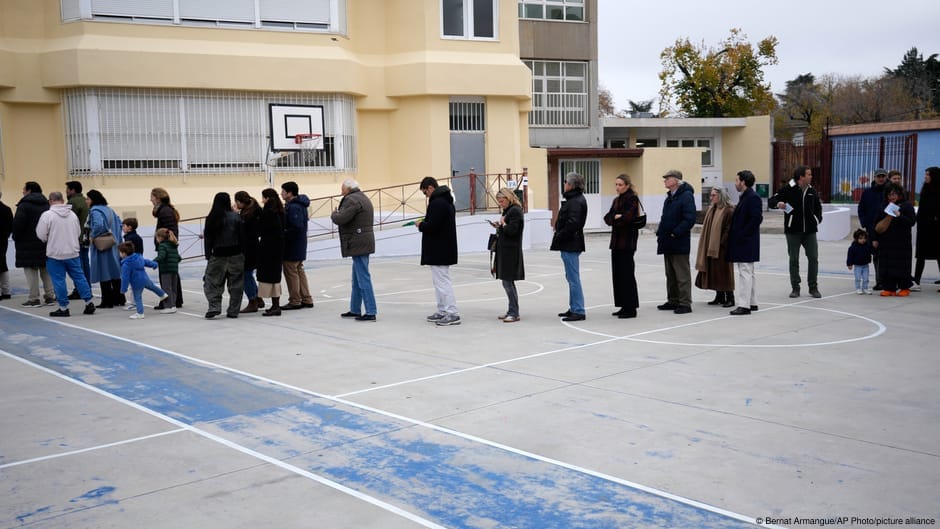
Polls have closed in Spain’s snap general election with early results indicating a lead for the conservative People’s Party (PP). The election was called after emergency housing measures proposed by Prime Minister Pedro Sánchez’s Socialist Party were defeated in parliament. Sánchez, a left-wing leader, had urged high voter turnout, framing the election as important for both Spain and Europe. Alberto Núñez Feijóo, leader of the PP, called on voters to cast ballots “with memory.” With over 30% of votes counted, the PP is ahead, and a Sigma Dos survey projects they, along with the hard-right Vox party, could secure a parliamentary majority. Turnout reached 78%, believed to be the highest in 40 years, approximately 15 percentage points higher than the 2023 election. A key issue in the election has been housing, highlighted by the case of 87-year-old Maricarmen Abascal, who was evicted from her Madrid apartment after her landlord sought to triple the rent. While Abascal was later allowed to return at a lower rent, she died before signing the new lease. Spain’s economy has experienced growth during Sánchez’s eight years in power, but many Spaniards report not feeling those gains due to rising costs of living.
Where they differ
- CBS News emphasized Sánchez’s positioning as a counterweight to Donald Trump and his cultivation of ties with the American left.
- DW highlighted the projected parliamentary majority for the PP and Vox, citing a Sigma Dos survey.
- The Guardian focused on reporting from the ground, noting that correspondents spoke to voters ahead of the vote.
What is not yet known
- The final election results are still pending, particularly in the Canary Islands.
- Whether the PP and Vox will ultimately form a governing coalition remains to be seen.
Background
- Spain held a snap general election after housing measures proposed by Prime Minister Pedro Sánchez’s Socialist Party were defeated in parliament [Fact Refinery, 2026-11-29].
- The case of 87-year-old Maricarmen Abascal, evicted from her Madrid apartment and later dying, became a key issue in the election, linked to a nationwide strike over the housing crisis [Fact Refinery, 2026-11-11].
- The People’s Party (PP), led by Alberto Núñez Feijóo, and the hard-right Vox party are projected to potentially secure a parliamentary majority [Fact Refinery, 2026-11-29].
- Spain has experienced two high-speed train crashes in under a year, leading to political fallout and the resignation of the Transport Minister [Fact Refinery, 2026-11-06, 2026-11-03].
Our reading
We begin by assessing the most likely outcome as a PP-Vox coalition government. The early results, coupled with the Sigma Dos survey cited by DW, strongly suggest this possibility. A key factor tipping the balance would be successful negotiations between the PP and Vox on coalition terms, particularly regarding Vox’s more controversial policies. A less likely scenario involves Sánchez attempting to form a coalition with smaller left-wing parties, but this would be significantly harder given the scale of the PP’s projected gains and the increased polarization of Spanish politics. Beyond the immediate government formation, this election has broader implications for Spain’s international positioning. CBS News’ emphasis on Sánchez’s stance against Trump and his ties to the American left highlights a potential shift in foreign policy should the conservatives take power. The increased voter turnout, approximately 15 percentage points higher than the 2023 election, suggests a heightened level of political engagement and dissatisfaction with the status quo. Considering the other side, Vox’s potential role in government is not without internal tensions. While benefiting from a conservative shift in the electorate, the party’s hard-right ideology may require compromises to achieve a stable coalition with the PP, potentially alienating some of its base. The party’s focus on “remigration” and prioritizing Spanish citizens for welfare could also create social divisions.
What to watch
- The final election results, particularly from the Canary Islands, to confirm the extent of the PP and Vox’s victory [various outlets, 2026-11-29].
- Confirmation of coalition negotiations between the PP and Vox, and the key policy areas they agree upon [various outlets, 2026-11-29].
- Any statements from Pedro Sánchez regarding the future of the Socialist Party and its role in opposition [various outlets, 2026-11-29].
Read the original coverage
💬 Comments
📜 Comment Policy