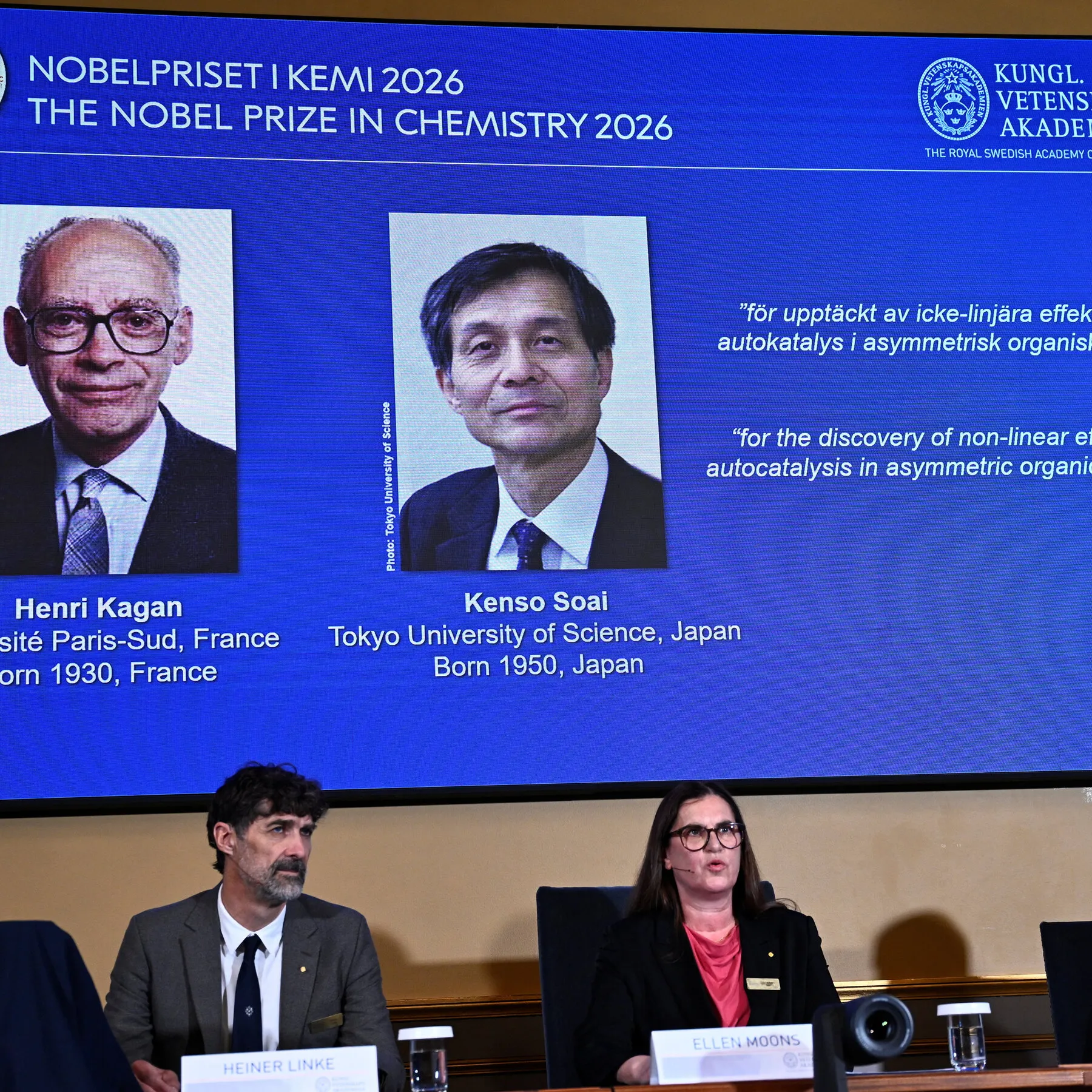
Henri B. Kagan and Kenso Soai have been jointly awarded the 2026 Nobel Prize in Chemistry for their discovery of non-linear effects and autocatalysis in asymmetric organic synthesis, resolving a century-old mystery of how molecules with mirror images can emerge spontaneously. Kagan, 95 and affiliated with Université Paris-Sud, first demonstrated a way to manipulate reactions to produce an excess of one mirror image in 1986. Soai, 76 and with the Tokyo University of Science, designed a reaction in 1995 that, by 2003, formed only one mirror image. The Royal Swedish Academy of Sciences recognized their work as decisive for the manufacture of pharmaceuticals.
The phenomenon of chirality, molecules existing as mirror images, has long puzzled scientists, as organisms utilize only one form of these molecules. Heiner Linke, chair of the Nobel Committee for Chemistry, described the duo’s discoveries as a solution to this longstanding chemical mystery and their reactions as “spectacular.”
Last year’s Chemistry Nobel went to Susumu Kitagawa, Richard Robson and Omar Yaghi for developing molecular structures that can trap gas. This year’s Nobel Prizes began with the award for medicine, recognizing work on optogenetics, followed by the physics prize for research on neutrinos. The prizes in literature, peace, and economic sciences will be announced in the coming days. The prize money totals 12 million Swedish kronor, approximately $1.2 million.
Read the original coverage
💬 Comments
📜 Comment Policy