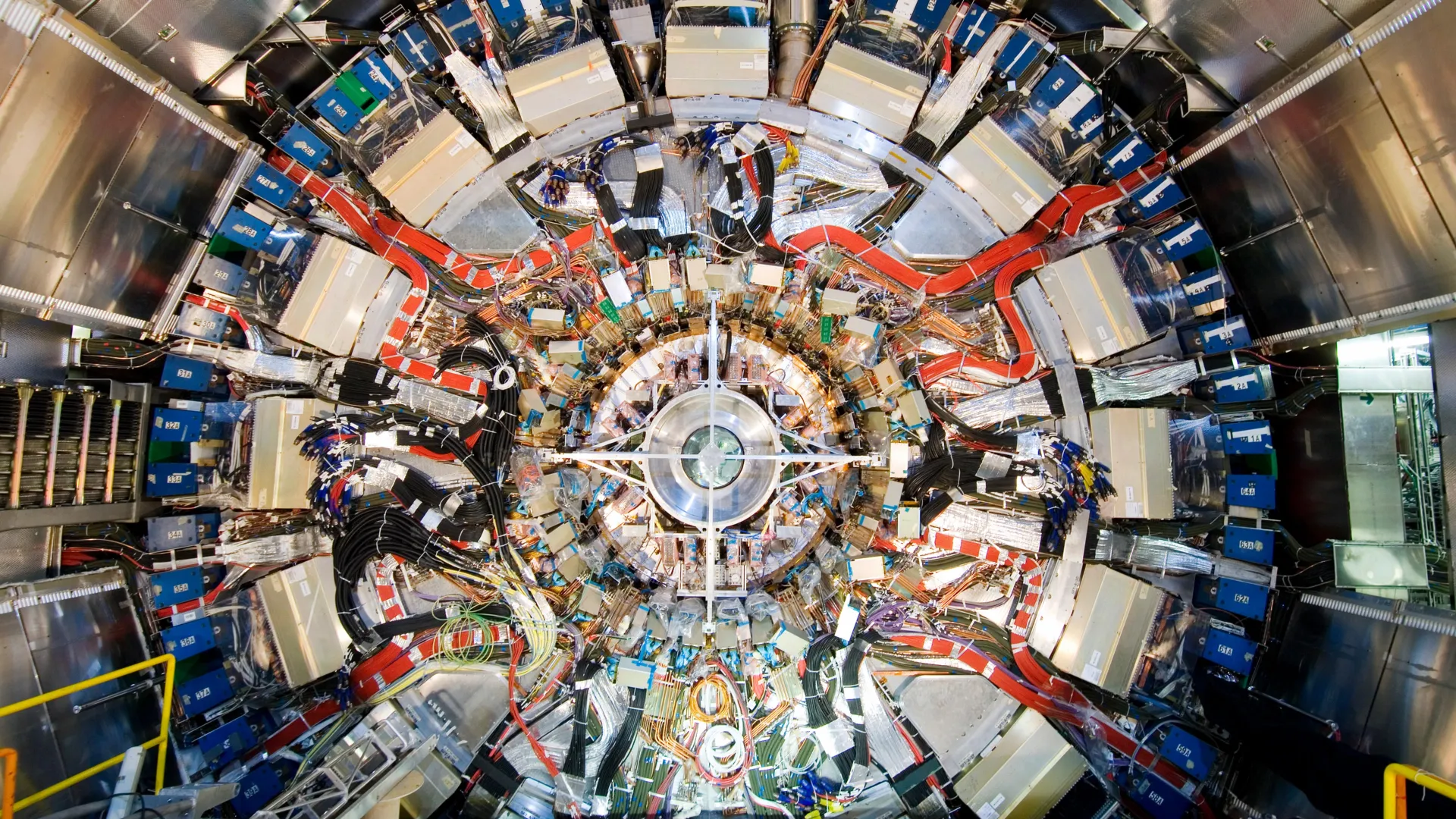
Physicists at the University of Oxford, working with data from CERN’s Large Hadron Collider, have found strong evidence that quantum entanglement persists even with heavy, short-lived Z bosons. This supports the validity of quantum mechanics under extreme conditions.
The research team detected entanglement in pairs of Z bosons created from the decay of Higgs bosons at the LHC. The Large Hadron Collider accelerates protons to 99.99% the speed of light, colliding them at energies reaching thirteen trillion electron volts to produce Higgs bosons. These Higgs bosons then briefly decay into two Z bosons, which subsequently decay into pairs of electrons or muons.
Researchers analyzed the angles at which the electrons and muons emerged from the Z boson decays to reconstruct the original Z bosons’ spins. This allowed them to observe entanglement, a phenomenon Albert Einstein famously termed “spooky action at a distance.” Previous observations of entanglement have involved photons, electrons, and trapped ions. This experiment demonstrates entanglement can occur even with particles that exist for only a tiny fraction of a second.
Quantum entanglement, where two particles share properties and influence each other even when separated, is a key feature of quantum mechanics and is central to technologies like quantum computers, secure communication networks, and advanced sensors. In quantum computing, entanglement enables the simultaneous manipulation of multiple qubits, accelerating calculations.
Read the original coverage
💬 Comments
📜 Comment Policy