BepiColombo Arrives at Mercury After Eight-Year Journey
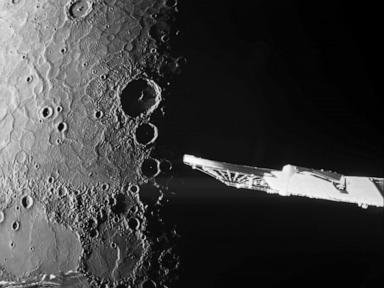
A pair of spacecraft, BepiColombo, a joint mission of the European Space Agency (ESA) and the Japan Aerospace Exploration Agency (JAXA), entered orbit around Mercury on Saturday after an eight-year journey covering more than 6 billion miles. The $2 billion mission is only the third to visit the planet, and the first in over a decade, following NASA’s Mariner 10 in the 1970s and Messenger in 2011-2015. After a series of thruster firings to counteract Mercury’s weak gravity, flight controllers in Germany confirmed the spacecraft’s arrival, though data analysis is ongoing. The two spacecraft comprising BepiColombo will separate next month to map and study Mercury’s interior, magnetic field, volcanic plains, and impact craters from different altitudes. Scientists, including lead project scientist Geraint Jones, anticipate unprecedented data collection beginning in the spring. The mission is planned to last at least one Earth year, equivalent to four Mercury years, and presents significant technical challenges due to Mercury’s extreme temperatures, exceeding 800 degrees Fahrenheit. The mission is named after the late Italian mathematician Giuseppe “Bepi” Colombo.
BepiColombo took a roundabout route to Mercury, utilizing gravity assists from Earth, Venus, and Mercury itself. The spacecraft shed its transfer module in September for the final leg of the journey. The mission aims to compare simultaneous measurements taken by the ESA and JAXA spacecraft, providing a comprehensive understanding of the planet’s dense interior and exterior. Mercury’s surface features include peaks reaching 3 miles high. Space agency officials are focused on keeping the spacecraft and its instruments cool throughout the mission's duration.
Read the original coverage
💬 Comments
📜 Comment Policy