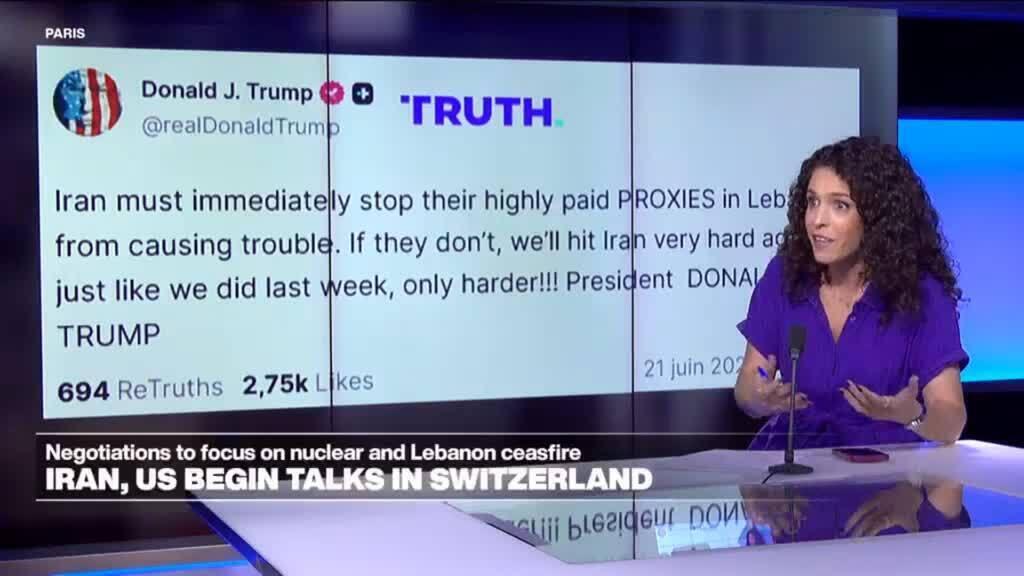
President Donald Trump issued a warning to Iran on Sunday, stating that the United States would resume bombing operations against the country if Hezbollah fighters in Lebanon continue their attacks on Israel. This threat was delivered as diplomatic efforts intensified, with Vice President J.D. Vance arriving in Switzerland to lead high-stakes nuclear negotiations between senior officials from the United States and Iran.
The dual developments highlight the complex geopolitical landscape facing the U.S. administration. While military posturing escalated through Trump’s public statements, parallel diplomatic channels were being activated to address broader regional tensions. The Vice President’s presence in Switzerland underscores the administration's focus on resolving nuclear issues, even as immediate security concerns regarding Hezbollah and Israel remain acute.
According to reports from The Washington Times, which is categorized as leaning right, Trump explicitly linked the potential for renewed military action against Iran to the actions of Hezbollah. The report notes that the threat was made "even as" Vice President Vance traveled to Switzerland. This juxtaposition suggests a strategy of combining diplomatic engagement with coercive military threats to influence Iranian behavior regarding its proxy forces in Lebanon.
France24, identified as far-left, reported on the same events, noting that Trump threatened to strike Iran if it did not stop Hezbollah from "causing trouble." The outlet emphasized the timing of these threats, stating they occurred "as peace talks between senior US and Iranian officials began in Switzerland." France24’s coverage highlights the diplomatic context, framing the military threats within the broader scope of ongoing negotiations aimed at de-escalation.
Both sources confirm that high-level discussions are underway in Switzerland. The presence of Vice President Vance indicates the significance the U.S. government places on these nuclear talks. However, the simultaneous threat from President Trump introduces a layer of uncertainty to the diplomatic process. The administration appears to be utilizing a multi-track approach: engaging directly with Iranian officials on nuclear matters while simultaneously signaling military readiness to deter Hezbollah’s activities in Lebanon.
The conflict in Lebanon remains a central point of contention. Hezbollah, a militant group and political party based in Lebanon, has been engaged in fighting with Israel. The U.S. position, as articulated by Trump, is that Iran bears responsibility for these actions due to its support for Hezbollah. By threatening to bomb Iran, the President is attempting to compel Tehran to restrain its allies.
The international community is watching these developments closely. The combination of military threats and diplomatic talks creates a volatile environment. If the negotiations in Switzerland fail to produce a framework that addresses Iranian support for regional proxies, the threat of bombing may be realized. Conversely, if diplomatic progress is made, the military pressure might serve as leverage to secure concessions.
As of Sunday, no immediate military actions have been reported. The focus remains on the outcome of the talks in Switzerland and whether they can lead to a sustained reduction in hostilities between Hezbollah and Israel, thereby averting the threatened U.S. strikes on Iranian territory. The situation remains fluid, with both diplomatic and military tools being employed simultaneously by the U.S. government.
Originale Berichterstattung lesen
💬 Kommentare
📜 Kommentar-Richtlinie