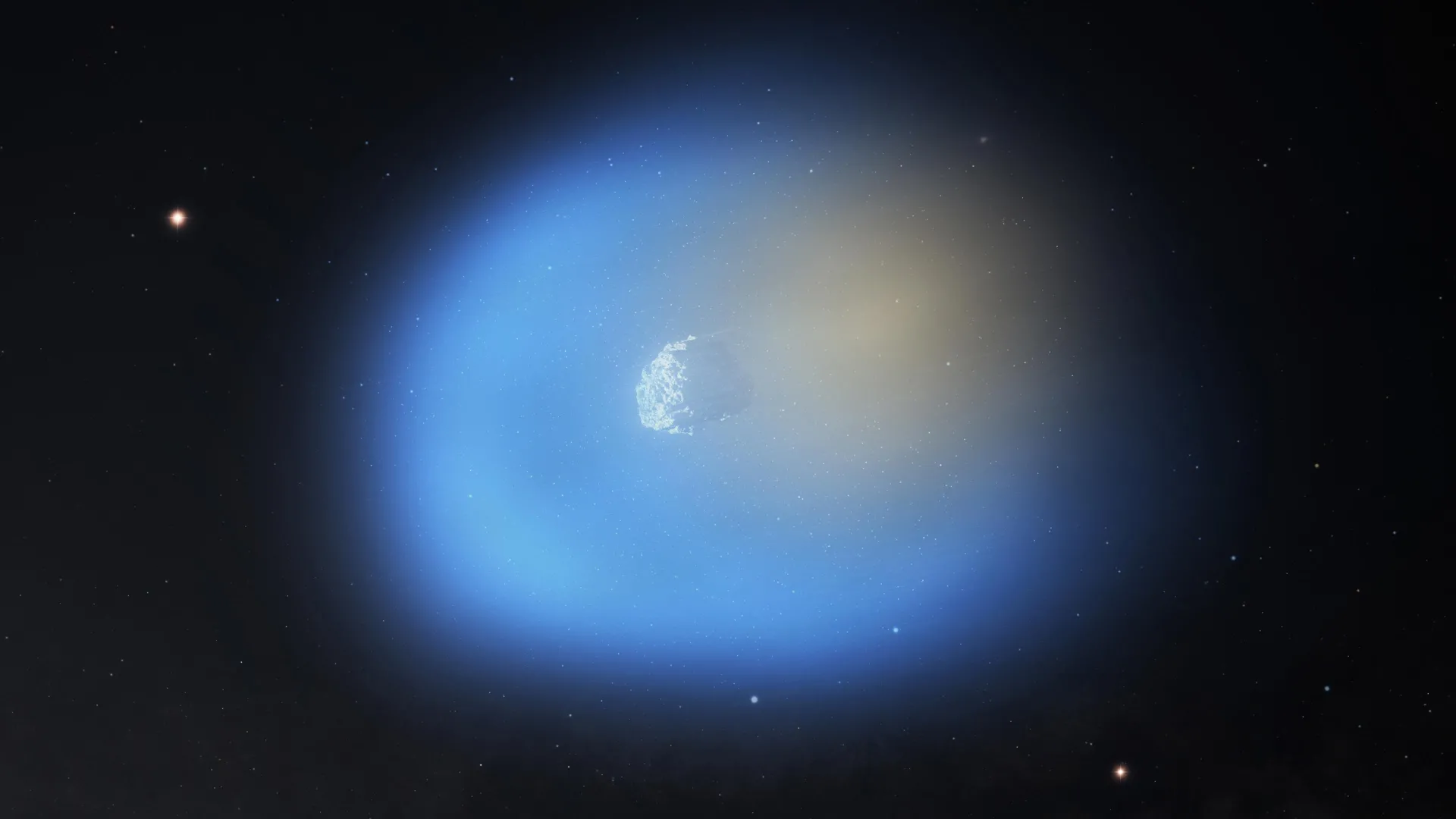
Astronomers have discovered unusually high levels of methanol in interstellar comet 3I/ATLAS, suggesting it formed under conditions different from those of most comets in our solar system. Observations from the Atacama Large Millimeter/submillimeter Array (ALMA) revealed the comet is releasing methanol from icy grains, providing a detailed look at an object originating from another star system.
New observations from ALMA show that 3I/ATLAS contains an unusually large amount of methanol. According to Nathan Roth, lead author of the research and a professor with American University, “Observing 3I/ATLAS is like taking a fingerprint from another solar system,” adding that the comet is “bursting with methanol in a way we just don't usually see in comets in our own solar system.”
The research team used ALMA’s Atacama Compact Array in Chile to observe 3I/ATLAS as it approached the Sun in late 2025. As sunlight heated the comet’s icy surface, gas and dust escaped, forming a coma around its core. By studying the molecules within this coma, astronomers identified the comet’s chemical makeup. The measurements provide a rare opportunity to investigate how small icy bodies may form in another planetary system.
The scientists focused on methanol (CH3OH) and hydrogen cyanide (HCN). ALMA revealed that 3I/ATLAS contains a high amount of methanol relative to hydrogen cyanide, with methanol-to-HCN ratios of roughly 70 and 120 on two observation dates. These values place 3I/ATLAS among the most methanol-rich solar system comets ever studied.
The measurements suggest the ice inside 3I/ATLAS formed under, or was later exposed to, conditions different from those experienced by most comets in our solar system. Earlier observations with the James Webb Space Telescope found that 3I/ATLAS had a coma dominated by carbon dioxide while still far from the Sun. The ALMA measurements add abundant methanol to the growing list of unusual features in the comet’s chemical makeup. ALMA’s high resolution also allowed astronomers to track how different molecules are released from the comet’s icy grains.
Originale Berichterstattung lesen
💬 Kommentare
📜 Kommentar-Richtlinie