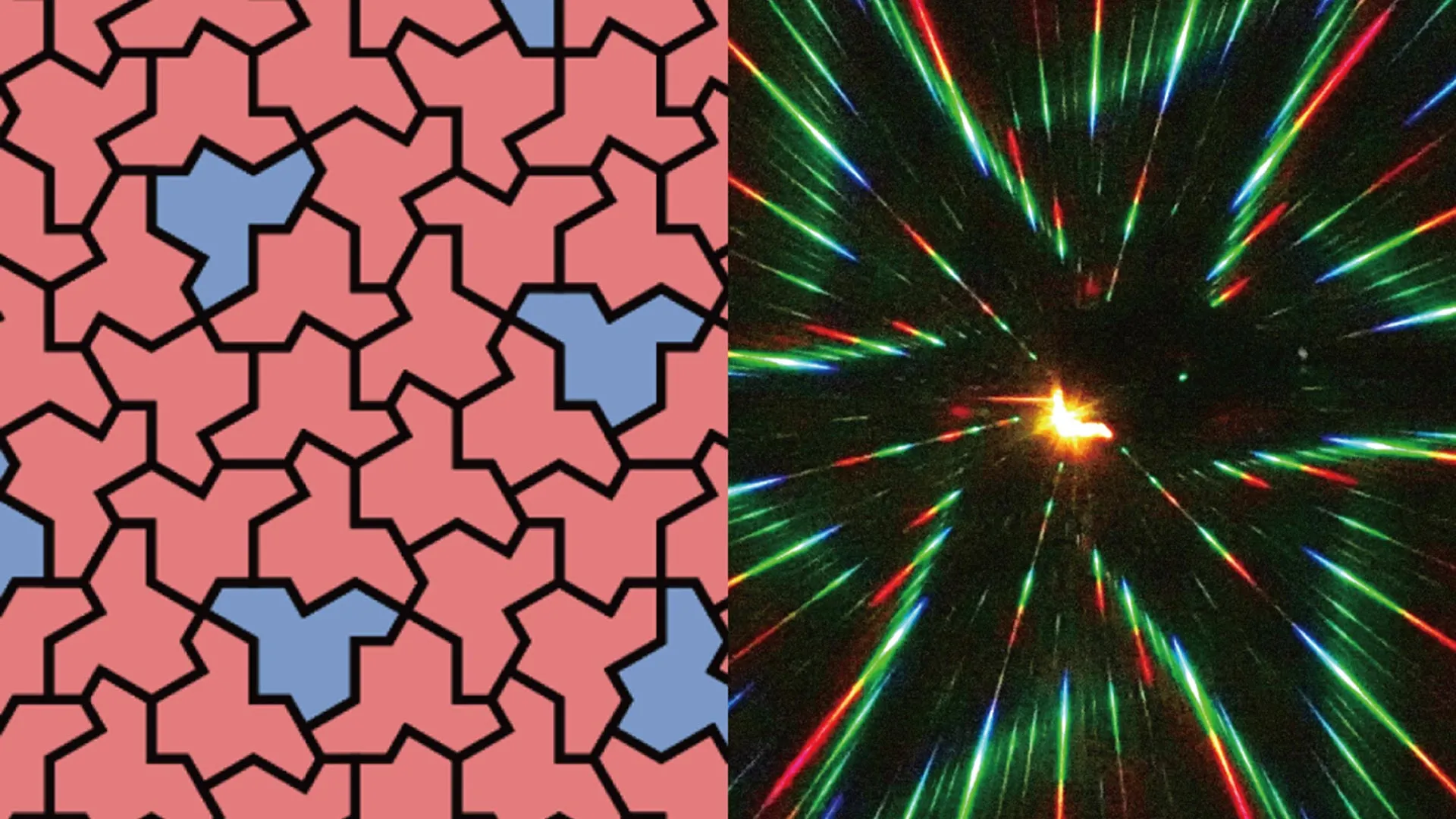
A mathematical shape, known as the Smith hat and recently used to solve a decades-old problem, has been found to manipulate light in unusual ways, potentially leading to new optical technologies. Researchers at the Institute of Industrial Science, The University of Tokyo, discovered that structures based on this shape create chiral patterns when illuminated with laser light.
The “Einstein problem” in mathematics concerns whether a single tile shape – a “monotile” – can cover an entire surface without repeating. In 2023, the Smith hat was identified as the first such monotile. Yuto Moritake, the lead author, explained the significance of the tile’s construction: “What is especially fascinating about the hat tile is that, although the resulting pattern appears irregular at first glance, it is actually constructed from the honeycomb lattice.” The team then investigated whether this unique shape could produce unexpected physical phenomena.
Researchers created nanoscale versions of the Smith hat pattern on silicon nitride films using electron beam lithography. When laser light was directed at these structures, the resulting diffraction patterns formed distinctive pinwheel-like shapes, revealing the structure’s chiral character. Chirality describes a property of asymmetry where a structure and its mirror image are not superimposable. In this case, the arrangement of the monotile caused the light itself to exhibit a chiral response.
Senior author Masaya Notomi explained, “We found that the diffraction patterns themselves become chiral because the structure lacks mirror symmetry.” He further stated that this optical response is “fundamentally different from that observed in conventional quasicrystalline materials.” The discovery could lead to new methods for controlling light, polarization, and the development of advanced optical devices.
Прочетете оригиналното отразяване
💬 Коментари
📜 Правила за коментари